Friday, February 18, 2011

OP ART

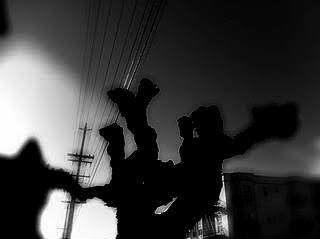
This class assignment involved taking pictures and using picnic to make the image hypnotic in order for this series to become part of Op Art. These images were developed with various effects that changed the color, contrast, and exposure in order to make a unique Op Art series.


Thursday, February 10, 2011

4 FRAME


This assignment was based on four frame images where I strived to make patterns and have leading lines connect to form a grid. I focused my images on landscape and street signs to capture various abstract images. These grids were based on six sections, which are, abstract, people, close up, large scale, patterns, and minimalism. All my images were developed through tilt-shift to bring out the contrast and exposure.  


Thursday, January 27, 2011

MULTI FRAME

This project consisted of creating a series of various multi-frame images that flow well with one another. In my project I decided to focus more on street signs and landscape to create a visual flow. These images were developed through tilt-shift in order to provide the images with more exposure and contrast. 

TRIPLE FRAME:


DOUBLE FRAME:


Thursday, January 20, 2011

NAME POEM

This project was based on self-expression and an opportunity to capture images of concepts that are significant to me, as students. This assignment entailed taking images of certain treasures that represent each letter in our names. For every letter in my name I picked a word that exemplified my hobbies, passions, and interests. I developed all these pictures through tilt-shift to provide the image with more contrast and exposure.    

V: Vibrant


L: Lovable


A: Athletic


D: Determined


Monday, January 10, 2011

Lewis Hine Biography

Lewis Hine was born on September 26th,1874  and raised in Oshkosh, Wisconsin. In his early years he was enrolled at the University of Chicago. After graduating Hine accepted a job as a schoolteacher in New York, hoping he could expand his career in this city. Hine purchased his first camera in 1903, to capture and document images from school events. This type of photography mesmerized him and after observing the child labor and poverty in New York he began to expand his career as a documentary photographer. These issues concerned Hine because as, a schoolteacher he, was concerned about the children of New York. In 1908 the National Child Labor Committee was intrigued by Hine's images and this political branch employed Hine as their staff investigator and photographer.


      Lewis Hine continued to expand his line of work by traveling to the country to capture images of children working in factories. Hine accurately took images of these situations to reveal his campaign against child labor. As a documentary photographer his portraits reveal self-expression and the idea of hope. His portraits portray images of children working in factories or sleeping on the street corners in order to emphasize sadness and depression.
      In 1916 the congress finally researched Hine's protests and arguments and agreed to pass a legislation stating the protection of children. In 1919 Hine returned to New York, after successfully proving his point and he moved on to another assignment involving the Red Cross during the First World War.
      There were several famous photographers who were either in the same line of work or took images on similar subjects as Lewis Hine. Jacob Riis and Dorothea Lange were two photographers who based their images on child labor. Jacob Riis was a photographer who came before Lewis Hines works, where as Dorothea Lange came after. 
Jacob Riis's Photographs:


Dorothea Lange's Photographs:  


Websites: 
-"Lewis Hine." Spartacus Educational - Home Page. N/A, n.d. Web. 6 Nov. 2010. <http://www.spartacus.schoolnet.co.uk/IRhine.htm>
-"Photography in the United States ." Spartacus Educational - Home Page. N/A, n.d. Web. 6 Nov. 2010. <http://www.spartacus.schoolnet.co.uk/USAphotographers.htm>
- "NYPL, Photography Collection." The New York Public Library. N/A, n.d. Web. 6 Nov. 2010. <http://legacy.www.nypl.org/research/chss/spe/art/photo/hinex/workport/work1.html>
- "Jacob Riis : Biography." Spartacus Educational - Home Page. N/A, n.d. Web. 18 Nov. 2010. < http://www.spartacus.schoolnet.co.uk/USAriis.htm>
- "Dorothea Lange - Women Come to the Front (Library of Congress Exhibition)." Library of Congress Home. N/A, n.d. Web. 18 Nov. 2010 < http://www.loc.gov/exhibits/wcf/wcf0013.html>
Books: Panzer, Mary. Lewis Hine . New York: Phaidon, 2002. Print.

Tuesday, January 4, 2011

SF MOMA REVIEW

Exposed
Exposed is a self-expressive way of photography, which brings together historical and modern images. These works are created by various artists and photographers, who capture detail focuses on a shot of life. This exhibition portrays various different concepts, such as the concept of "surveillance" and witnessing violence. The collection of images in the "Exposed" series reveal the notion of "life" photography, where artists strive to capture everyday occurrences that are not acknowledged. Some famous images in this series are Atlanta by Harry Callahan, and New York by Garry Winngrand. These two photographers portrayed very mesmerizing images of various incidents and activities revealed on busy streets of distinct cities. 


Henri Cartier-Bresson
Henri Cartier-Bresson is a prominent artist and photojournalist who is viewed as the most prosperous and unique artists in the history of photography. He developed and revolutionized photography into what it is today. Through various technics he was able to capture images of "life", such as imperative occurrences around him. Many of his works were displayed through detailed and symbolic portraits. Cartier-Bresson focused on facial expressions and brought out each individuals uniqueness. The portrait called Calle Cuauhtemoctzin, taken by Cartier-Bresson reveals the notion of self-expression and facial emotions. 


Wednesday, December 8, 2010

FINAL DREAM STREET SEIRES

This is the final series of the Dream Street project that reveals all the best treasures that I found throughout the three drafts. I have continued to develop these images so that they could stand out in color and shades. This final project allowed me to focus in on everything that I learned about photography and post it all in one final series. These images were processed through tilt-shift and they were captured from different angles to portray the idea of self-expression. 

Significant


Landscape